Is the Ten Thousand Buddhas Monastery Worth Visiting? An Honest Guide
Short answer: yes, the Ten Thousand Buddhas Monastery is worth visiting, as long as you know it starts with a climb and you go for the atmosphere rather than a big-ticket attraction. It is free, it is a five-minute walk from an MTR station, and the walk up is genuinely unlike anything else in Hong Kong. I have sent friends here on a spare half-day and none of them regretted it.
That said, it is not for everyone. If steep steps are a problem for you, or you only have time for the headline sights, this one is easy to skip. Here is an honest look at what you actually get for the effort.
What the Ten Thousand Buddhas Monastery actually is
It sits at 220 Pai Tau Village in Sha Tin, up a wooded hillside in the New Territories. It was founded in 1949 by the Venerable Yuet Kai, and the complex was finished in 1957. One quirk worth knowing before you go: despite the name, it is not a working monastery. There are no resident monks, and it is run by laypeople. The main temple and the pagoda are both listed as Grade III historic buildings.
The name undersells it, too. The main hall holds close to 13,000 small gilded Buddha statues lining the walls, not ten thousand. It is the kind of place that photographs far better than it sounds on paper.
The climb: 431 steps and the golden statues
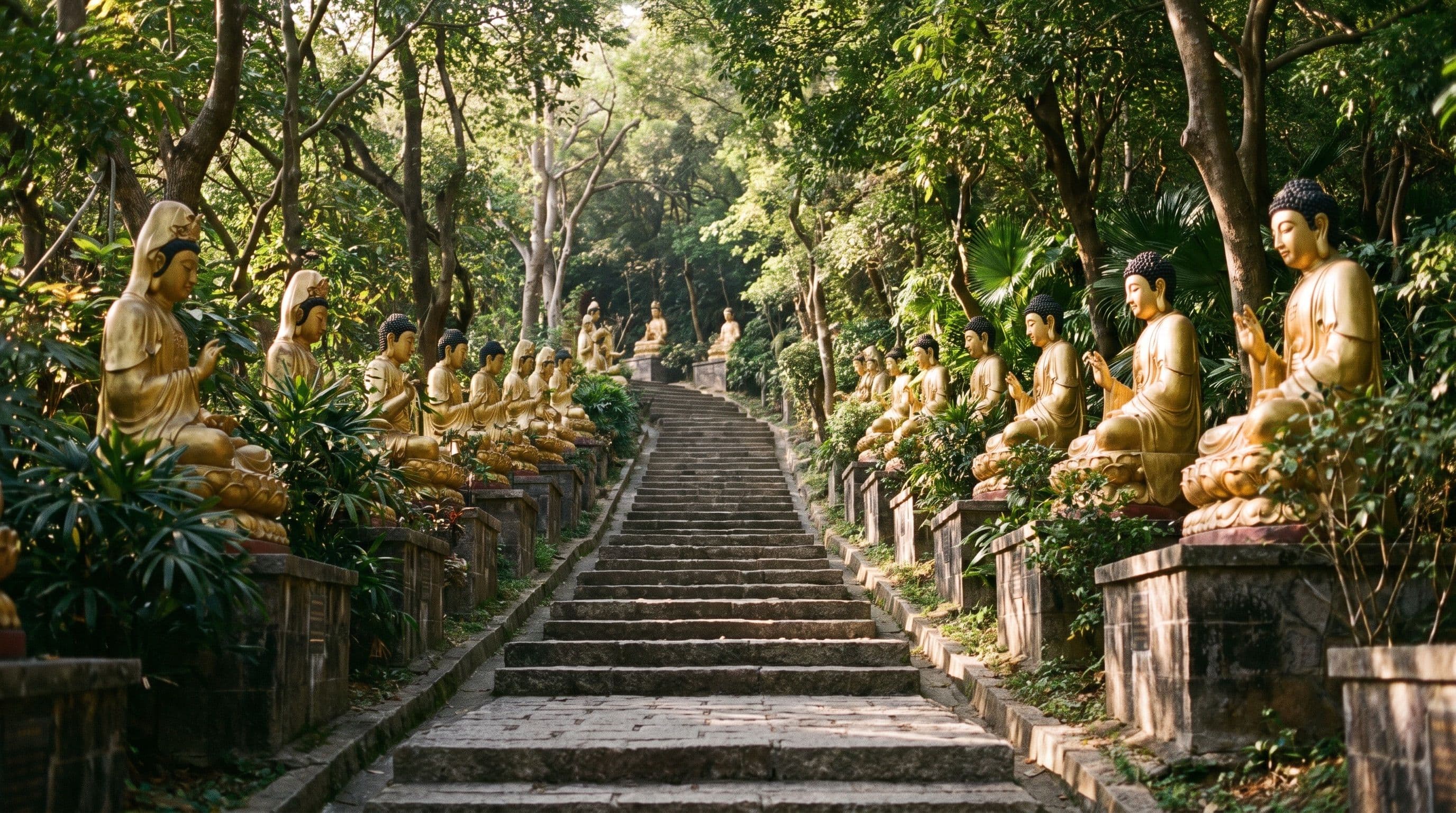
The part everyone remembers is the path up. It is 431 steps to the main level, with roughly another 69 steps if you carry on to the upper terrace. Both sides of the lower staircase are lined with life-size golden statues, each in a different pose and with a different face, so the climb is the attraction rather than just the way to reach it. You are not slogging up a blank stairwell. You are walking past hundreds of gold figures the whole way.
It is a steep hillside and the steps are uneven in places, but there is a paved concrete ramp running alongside them, which helps. Most reasonably mobile people manage it in a slow ten to fifteen minutes with photo stops. If stairs are genuinely difficult for you, this is the honest dealbreaker, because there is no lift or shuttle.
One warning that is easy to laugh off until it happens: there are wild monkeys along the path, and they can get bold if they smell food. Keep snacks zipped away and do not eat on the climb.
What you see at the top
At the main level you reach the Ten Thousand Buddha Hall with its walls of tiny gold figures, plus several halls, a couple of pavilions, and a nine-storey red pagoda that is one of the most photographed spots in Sha Tin. The pagoda is sometimes closed to go inside, so treat climbing it as a bonus rather than a plan. From up here you also get a decent view back over Sha Tin.
Give yourself about 1.5 to 2 hours if you want to see it properly, including the climb, the main hall and a wander around the upper terrace. If you are just after the pagoda photo and a quick look, an hour is enough.
Is it worth it? My honest take
For a free attraction this close to the city, the value is hard to argue with. You get an offbeat temple site, a memorable walk, and photos that do not look like everyone else's Victoria Harbour shot. It pairs well with a wider New Territories day, and Sha Tin sits right on the MTR East Rail Line, so it is an easy add-on rather than a big expedition. If you are the kind of traveller who likes the quieter, more local side of Hong Kong, this earns its place on the list.
Skip it if the steps are a problem, if it is pouring, or if your trip is short and you would rather spend the half-day on a paid headliner. If you are weighing it against other sights, our roundup of the top attractions in Hong Kong helps you see where a free temple like this fits against the ticketed big hitters. For a very different but equally iconic climb, compare it with the trip out to the Big Buddha on Lantau.
How to get there and what it costs
Take the MTR to Sha Tin station and leave by Exit B. Go down the ramp and follow the pavement to Pai Tau Street, near the Home Square shopping centre. Turn left, then quickly right onto Sheung Wo Che Road, passing the government offices, and follow it to the small path that leads up to the entrance. It is about a five-minute walk from the station.
Two things trip people up at the bottom. First, avoid the cemetery gates nearby, which are easy to mistake for the entrance. Second, ignore anyone soliciting donations or steering you into a side "temple" near the base, as these are not the monastery itself. The real thing is free and never charges to enter.
Getting around Sha Tin and the rest of the city is simplest with a stored-value card, so it is worth reading our guide to getting from the airport into the city before you start tapping through the MTR.
Quick answers
Is the Ten Thousand Buddhas Monastery free? Yes. There is no admission fee. Donations are accepted but never required, and anyone charging you at the base is not the real monastery.
How many steps are there? It is 431 steps up to the main level, with about another 69 to the upper terrace. A paved ramp runs alongside the stairs.
How long should I spend there? Allow 1.5 to 2 hours to see it properly, or about an hour for a quicker visit.
What are the opening hours? It is generally open daily from 9am to 5pm. Go in the morning to beat the heat on the climb.
How do I get there? Take the MTR to Sha Tin, use Exit B, and walk about five minutes through Pai Tau Village to the entrance.
Are there really monkeys? Yes, wild monkeys live along the path and can be pushy around food, so keep snacks out of sight.
Planning the rest of your trip? See our guide to The Central–Mid-Levels Escalator: What It Is, How to Ride It & What to See.
Planning the rest of your trip? See our guide to Is Kowloon Walled City Park Worth Visiting?.