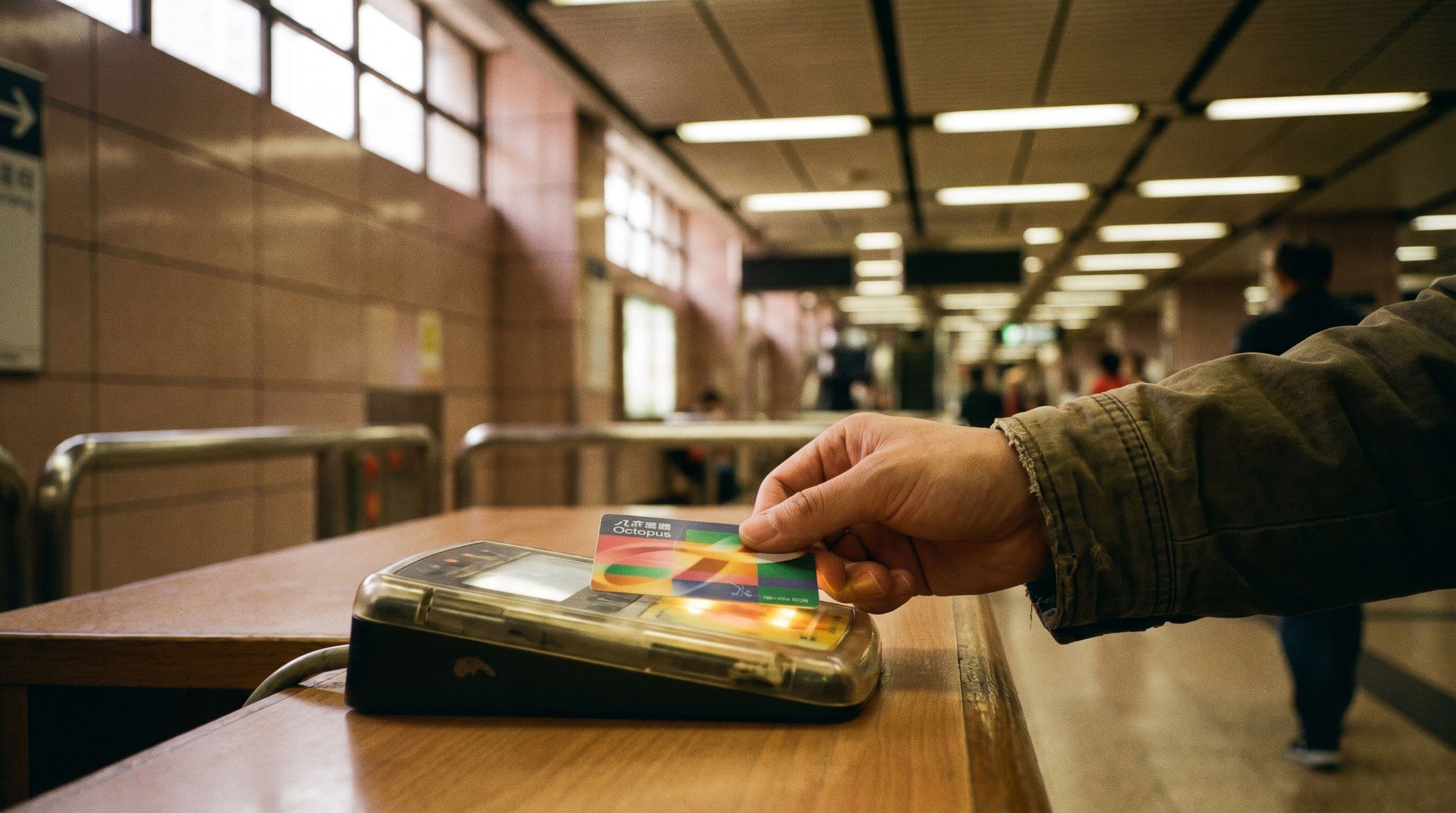
Octopus Card vs MTR Tourist Day Pass: Which Is Better for Tourists?

If you've landed at Hong Kong International Airport and you're staring at two ticket counters wondering which piece of plastic to buy, here's the short version: for almost every visitor, the Octopus Card beats the MTR Tourist Day Pass. The Day Pass only wins in one specific situation, and it's rarer than you'd think.
I've used both. The Day Pass sounds efficient on paper: one price, unlimited rides, no tapping in and out to think about. In practice it locks you into the MTR network for exactly one day and then becomes a HK$75 souvenir. Here's the actual comparison.
Quick answer
Buy the Octopus Card unless you know, before you land, that you'll ride the MTR six or more times in a single 24-hour window and won't need buses, trams, ferries or convenience stores that day. That's the only scenario where the Tourist Day Pass's flat HK$75 comes out ahead.
What each one actually costs
The Tourist Octopus (Sold version) is HK$39, with no deposit and no stored value loaded. You top it up yourself with cash, a credit card, or at a 7-Eleven or Circle K counter. Any balance left when you're done can be refunded (the card itself is then deactivated), so the HK$39 is close to the only money you're committing upfront. If you'd rather use a reloadable On-Loan Octopus instead, that's a HK$50 refundable deposit plus HK$150 of stored value for an adult card, both of which you get back when you return the card.
The MTR Tourist Day Pass, per MTR's own tourist ticket page, is a flat HK$75 for an adult (HK$35 for a child aged 3-11). You show a passport or similar proof of tourist status to buy it, and it's only sold to visitors who've been in Hong Kong less than 14 days. Once activated, it covers unlimited rides on the MTR, Light Rail and MTR Bus for any one calendar day of your choosing. The 24 hours start counting from your first tap-in, not from the moment you buy it, and the pass itself stays valid for a month so you can pick which day to use it. It does not cover the Airport Express, East Rail Line First Class carriages, or journeys to/from Lo Wu or Lok Ma Chau. It's non-refundable and can't be exchanged for cash, used or not.
Where the Octopus Card wins
- It works everywhere, not just the MTR. Buses, minibuses, trams, the Star Ferry, taxis that accept it, and pretty much every convenience store, supermarket and fast-food counter in the city. The Day Pass is MTR-only.
- You're not locked to one day. A Tourist Octopus works for your whole trip, however many days that is, and you only pay for the rides you actually take.
- You get your money back. Unused balance on a Tourist Octopus is refundable. A Day Pass you don't fully use is just a sunk HK$75. See our guide to getting your Octopus refund before you fly home.
- Most trips don't hit six MTR rides in a day. A typical sightseeing day, hotel to an attraction, attraction to lunch, lunch to another stop, back to the hotel, is usually four rides or fewer. On pay-as-you-go Octopus fares, that rarely adds up to HK$75.
Where the Day Pass can make sense
If you've mapped out a genuinely MTR-heavy day, say a point-to-point tour hitting several distant districts back to back, all reachable only by train, with no buses, ferries or shops in between, the flat HK$75 can beat paying per ride. The catch is you have to be fairly confident about that before you start tapping, since the pass isn't refundable if the day turns out lighter than planned. In my experience this is a narrow use case: most multi-stop days end up mixing in at least one bus, tram or ferry leg, which the Day Pass doesn't cover at all.
What about topping up as you go?
One thing that trips people up: you don't need to preload a huge balance onto your Octopus to make it worth having. You can top up in small amounts at MTR stations, 7-Eleven and Circle K as your balance runs low, so there's no pass-vs-pay-per-ride math to do mid-trip.
If you're arriving via the Airport Express
Neither card covers the Airport Express. Octopus is accepted for other transport and shopping around the city, but the Airport Express itself is priced and ticketed separately, and the Tourist Day Pass explicitly excludes it. If your first move in Hong Kong is the ride into town, our airport-to-city guide compares that leg on its own.
Quick answers
Is it better to get an Octopus Card or a tourist pass?
For almost everyone, the Octopus Card. It works on more than just the MTR, isn't locked to a single day, and refunds unused value. The Day Pass only pays off if you're certain you'll take six or more MTR-only rides in one day.
Is the Hong Kong Tourist Day Pass worth it?
Only for a heavy, MTR-only day of travel. For typical sightseeing that mixes in buses, trams, ferries or shops, the flat HK$75 usually costs more than paying per ride on Octopus.
Is the MTR cheaper with an Octopus Card?
Yes, Octopus fares on the MTR are lower than the equivalent Single Journey Ticket paid in cash, on top of working across other transport modes the Day Pass doesn't touch.
Which Octopus Card is best for tourists?
The Tourist Octopus (Sold version) at HK$39 with no deposit is the simplest option for a single trip. You top it up as needed and can refund the balance before you leave. If you're travelling for longer or expect heavier use, the reloadable On-Loan Octopus (HK$50 deposit) is the alternative.
Planning the rest of your trip? See our guide to How to Check Your Octopus Card Balance in Hong Kong (With & Without the App).