Cape D'Aguilar, Hong Kong: The Wild Lighthouse Walk (and Its Whale Skeleton)
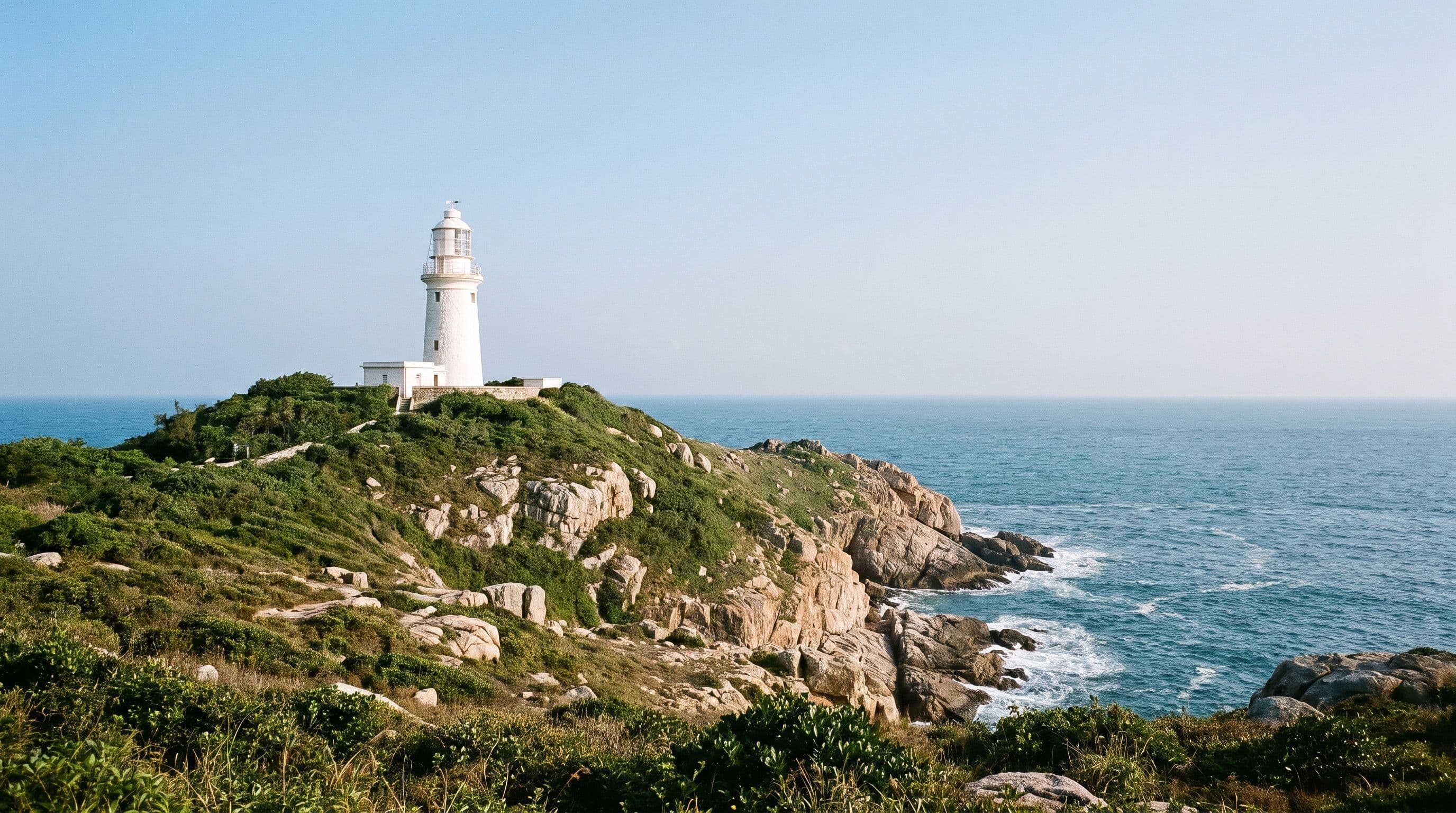
Cape D'Aguilar sits at the southeastern tip of Hong Kong Island, on the same D'Aguilar Peninsula as the far busier Dragon's Back ridge, past Shek O, where the city just stops and a rocky headland takes over. It's home to Hong Kong's oldest lighthouse, its only marine reserve, and a whale skeleton with a stranger recent history than the trail signs let on. There's no MTR station anywhere near it and no ticket booth once you arrive, which is most of the appeal: it's one of the few Hong Kong Island walks that still feels genuinely out of the way.
How to get to Cape D'Aguilar
Take the MTR Island Line to Shau Kei Wan station and leave via Exit A3. Bus 9 to Shek O stops right outside, but not every Bus 9 continues to Cape D'Aguilar Road, so check the electronic board or ask the driver before boarding. Green minibuses run from the same exit and are a reliable backup if you miss the right bus. Get off at the Cape D'Aguilar Road stop, which is also the trailhead: from here it's a sealed access road the rest of the way, no MTR or tram option gets you any closer.
The walk itself
From the bus stop it's about 7.1km round trip and just under two hours at an easy pace, with roughly 187m of gentle climbing spread across the whole route. That sounds like more of a hike than it is: almost the entire way is a paved access road built for the old wireless station and marine reserve buildings, not a dirt trail, so it's manageable in trainers and doable with kids. The one exception is the short detour up to the old WWII battery position, which is a steeper, unpaved scramble if you want to take it. Along the way you'll pass Thunder Cave, a sea cave where the swell booms audibly against the rock, and Crab's Eye Cave, a smaller arch worth a look if the tide's out. There's a toilet block within the first kilometre and a vending machine at the Marine Reserve building selling water, but no food anywhere on the route, so bring your own.
The lighthouse
Cape D'Aguilar Lighthouse went into service on 16 April 1875, which makes it the oldest surviving lighthouse in Hong Kong. It's a 9.7-metre round granite tower with a rustic stone base and an arched doorway, named after Major-General Sir George Charles D'Aguilar, Lieutenant Governor of Hong Kong from 1843 to 1848. It was actually taken out of service in 1896 once the newer Waglan Island Lighthouse took over, and its light apparatus was moved to Green Island in 1905. The lantern wasn't relit until 1975, this time automated, and it's still operated by the Marine Department today. It was declared a monument in 2005, but it's not open to the public for security and operational reasons, so the visit is about seeing it from outside, not going in.
The whale skeleton, and why it isn't the one from the old photos
The whale skeleton on display near the water, known as the Bones of Miss Willy, has a more complicated recent history than most trail guides mention. The original skeleton went up outdoors at Cape D'Aguilar in 1991, in front of the University of Hong Kong's Swire Institute of Marine Science, after years on indoor display at HKU. Super Typhoon Mangkhut damaged it in 2018, and by 2021 the bones had become too fragile to leave outside, so the Institute removed them. A 3D-printed replica went up in summer 2024 but lasted only six months before the sun turned the plastic yellow and it had to come down too. The skeleton you'll see today, installed in November 2025, is a fibreglass replica built from a 3D scan of the original bones by a company that makes dinosaur skeletons for theme parks, with a protective coating meant to survive the weather better this time. The real bones are now kept in a classroom at the Institute rather than outdoors.
It's a marine reserve, not a beach
Cape D'Aguilar is Hong Kong's only marine reserve, designated under the Marine Parks Ordinance in 1996, and the rules are stricter than at an ordinary country park: swimming, boating, fishing, and collecting any animal, plant, or shell is prohibited in the water and along the shoreline. That's a firmer line than the one at Sai Wan Swimming Shed further west, where you can actually get in the water; here the point is to leave it alone, and it's why the marine life is worth protecting in the first place. The reserve holds a meaningful share of the species recorded in Hong Kong waters precisely because nobody's allowed to fish or collect from it. Treat it the way you would the Monster Building, another Hong Kong sight where the etiquette matters as much as the visit: the Marine Reserve building and the radio station further along the road are functioning facilities, not photo backdrops, so stick to the public path.
Pair it with another Hong Kong Island walk
Cape D'Aguilar only takes up a morning, and it's an easy add-on to a Hong Kong Island day rather than a trip on its own. If you want a second car-free walk the same day, the Lugard Road walk around Victoria Peak is on the opposite side of the island and just as flat, or head back through Shau Kei Wan toward Dragon's Back if you'd rather trade sea caves for ridge views.
Quick answers
How difficult is the hike to Cape D'Aguilar? Easy by Hong Kong standards. It's about 7.1km round trip on a paved road with only around 187m of total climbing, so it suits trainers and most fitness levels; the one steeper stretch is the optional detour to the old WWII battery.
Is there really a whale skeleton at Cape D'Aguilar? Yes, but it's a fibreglass replica installed in November 2025, not the original. The real bones went up in 1991, were damaged by a 2018 typhoon, removed in 2021, and a first replica failed within six months in 2024 before this sturdier one replaced it.
Can you swim or fish at Cape D'Aguilar? No. It's Hong Kong's only marine reserve, designated in 1996, and swimming, boating, fishing, and collecting marine life are all prohibited there.
Can you go inside the Cape D'Aguilar Lighthouse? No. It's still an active navigational light run by the Marine Department and isn't open to visitors, though you can walk right up to it from outside.