Riding Hong Kong's Green Minibuses: How to Pay & When to Get Off
The green minibus is the fastest way to get around Hong Kong that almost no first-time visitor tries, because nothing about it looks like it's meant for tourists. There's no English announcement, no obvious stop button, and the driver expects you to already know where you're getting off. This hong kong minibus guide covers how the two colours actually differ, how to pay, and how to flag one down and get off without holding up the bus.
Green or red: what's the difference?
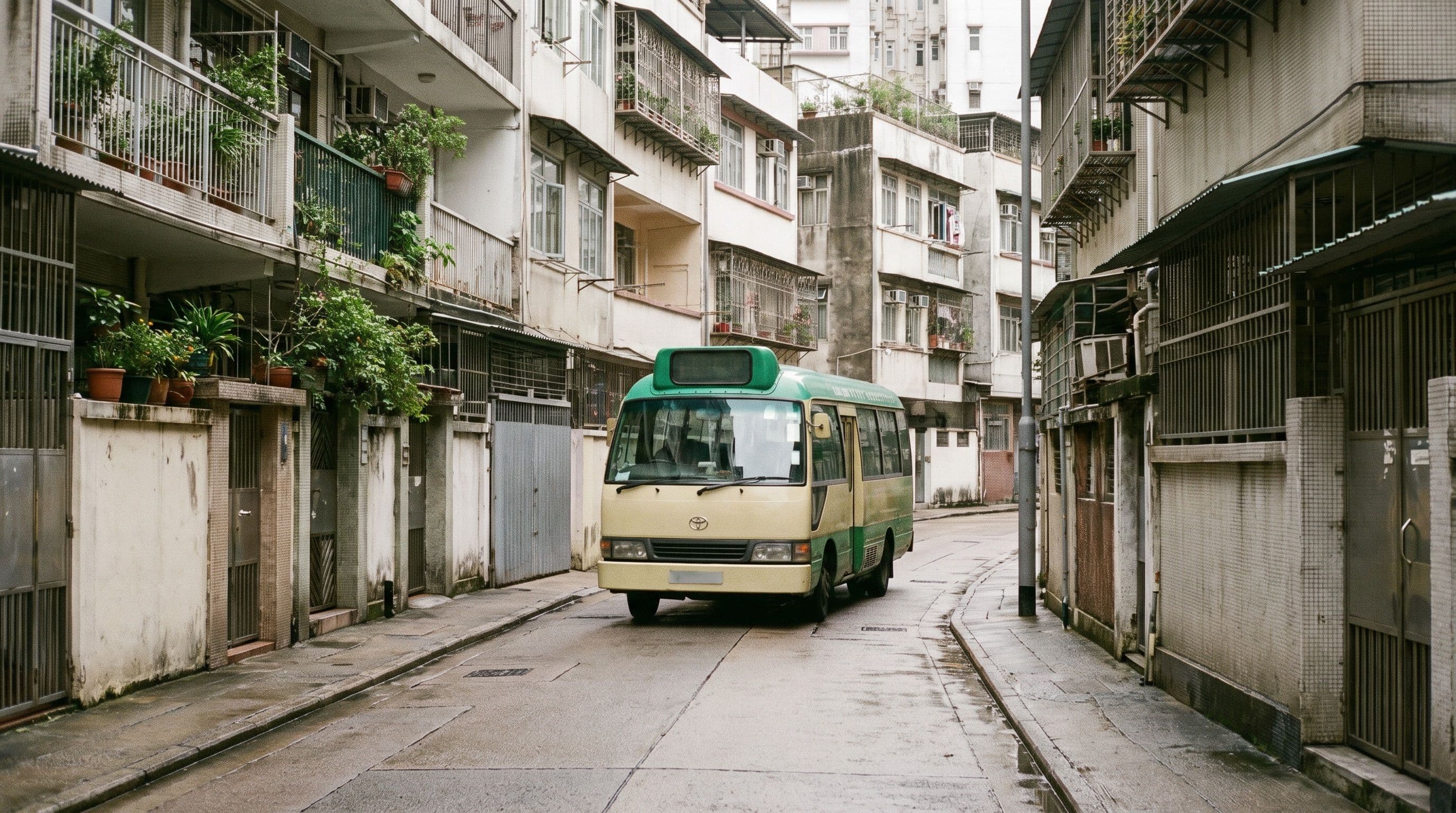
Hong Kong runs two kinds of minibus, or public light bus (PLB), and the roof colour tells you which set of rules you're under. As of September 2025 there were 3,357 licensed green minibuses running 361 fixed routes (67 on Hong Kong Island, 83 in Kowloon, 211 in the New Territories), carrying about 1,329,100 passengers a day, according to the Transport Department. Green minibuses run on fixed routes with a scheduled headway and fixed fares, and you can only board and alight at designated stops.
Red minibuses are privately operated: 707 were licensed as of September 2025, carrying around 135,100 passengers daily. Their route, timing and fare aren't set by the Transport Department, so drivers have real flexibility on the path they take, and you can flag one down or ask to get off almost anywhere the law allows the bus to stop. Red minibuses show their destination in the front window rather than a route number, and they often wait until full before leaving the starting point.
How to pay
Every green minibus accepts Octopus, tapped on a reader by the driver's seat, and every green minibus also takes cash if your card is empty. Fares are fixed and posted in the window or on the Octopus reader itself; real examples on Hong Kong Island run from around HK$6 for a short hop (Admiralty to North Point) up to HK$11.50 for a longer cross-district route (Causeway Bay to Cyberport), with longer New Territories routes costing more.
Red minibuses are a different story: some now take Octopus, but plenty are still cash-only, and exact change is preferred even though drivers will usually make change from a HK$20 or HK$50 note if you don't have it. There's no posted fare list on a red minibus the way there is on green, so if you're not sure what a route costs, ask the driver or another passenger before you sit down.
How to flag one down and board
For a green minibus, you need to be standing at an actual stop; it won't pull over for you anywhere else. If the driver holds up one or two fingers as they approach a stop with a small crowd waiting, that's how many seats are left, and everyone beyond that number should let the people ahead board first. Once you're on, tap your Octopus or hand over cash straight away. Some minibuses have seatbelts fitted; if yours does, use it, because minibus drivers do not hang around.
Red minibuses can be flagged down anywhere traffic rules allow a stop, not just at a marked point. Because many red minibuses don't have a route number on display, only a destination name, it helps to know the name of where you're headed before you wave one down.
How to signal your stop
Most green minibuses now have a bell, the same idea as a city bus: press it with enough notice before your stop and the driver will pull in. Red minibuses generally don't have a bell, so you need to call out to the driver directly. "Yau lok mm goi" (getting off, please) is the standard phrase. If there's no clear stop coming up, "baa si zaam yau lok" (I want to get off at the bus stop) or naming a landmark works too. If the driver has heard you, they'll usually raise a hand to confirm before pulling over.
Miss your moment and nobody acknowledges the shout, and the honest answer is you ride to the next stop and try again. It happens to residents too, not just visitors.
Routes worth knowing
Green minibus route 1 runs from Hong Kong Station, under IFC, up to the Peak, and is a faster (if less scenic) alternative to the Peak Tram and other ways up the hill. Route 40 connects Causeway Bay to Stanley Market past Deep Water Bay and Repulse Bay, and route 4C gets you from Causeway Bay to Aberdeen through the Aberdeen Tunnel in a fraction of the time an MTR-plus-walk route would take. If you're heading to Sai Kung from town, minibus 1A runs from Choi Hung MTR to Sai Kung pier and gets genuinely busy with commuters around 6–7pm.
Google Maps' public transport directions are unreliable for minibus routes in Hong Kong; several routes show up with the wrong streets or missing stops entirely. Citymapper is the better app for this specifically, and 16seats.net has a route and fare directory for both green and red minibuses if you want to check one before you leave.
Quick answers
What's the difference between green and red minibuses in Hong Kong? Green minibuses run fixed routes, fixed stops and fixed fares, and take Octopus or cash. Red minibuses have flexible routes and stops, are often cash-only, and don't publish a fixed fare list.
Can you pay a Hong Kong minibus with Octopus? Yes on every green minibus. On red minibuses it depends on the vehicle; carry small notes as a backup.
How do you get off a Hong Kong minibus? Press the bell if there is one (most green minibuses have one). On a red minibus, or a green one without a bell, call out "yau lok mm goi" with enough notice before your stop.
Where do you catch a green minibus in Hong Kong? Only at a designated stop, the same as a regular bus stop. Red minibuses can be flagged down almost anywhere traffic allows a stop.
Minibuses are one option among several for getting around; see how they compare to the Hong Kong tram for cross-island trips, or the Star Ferry if you're crossing the harbour instead. If you're just in from the airport, see every option for getting from the airport to the city for the first leg before you're navigating minibuses at all.
Planning the rest of your trip? See our guide to Best Hong Kong Bus App for Tourists: What to Download & How to Use It.