Hong Kong Taxi Guide: Fares, Apps & How to Book One
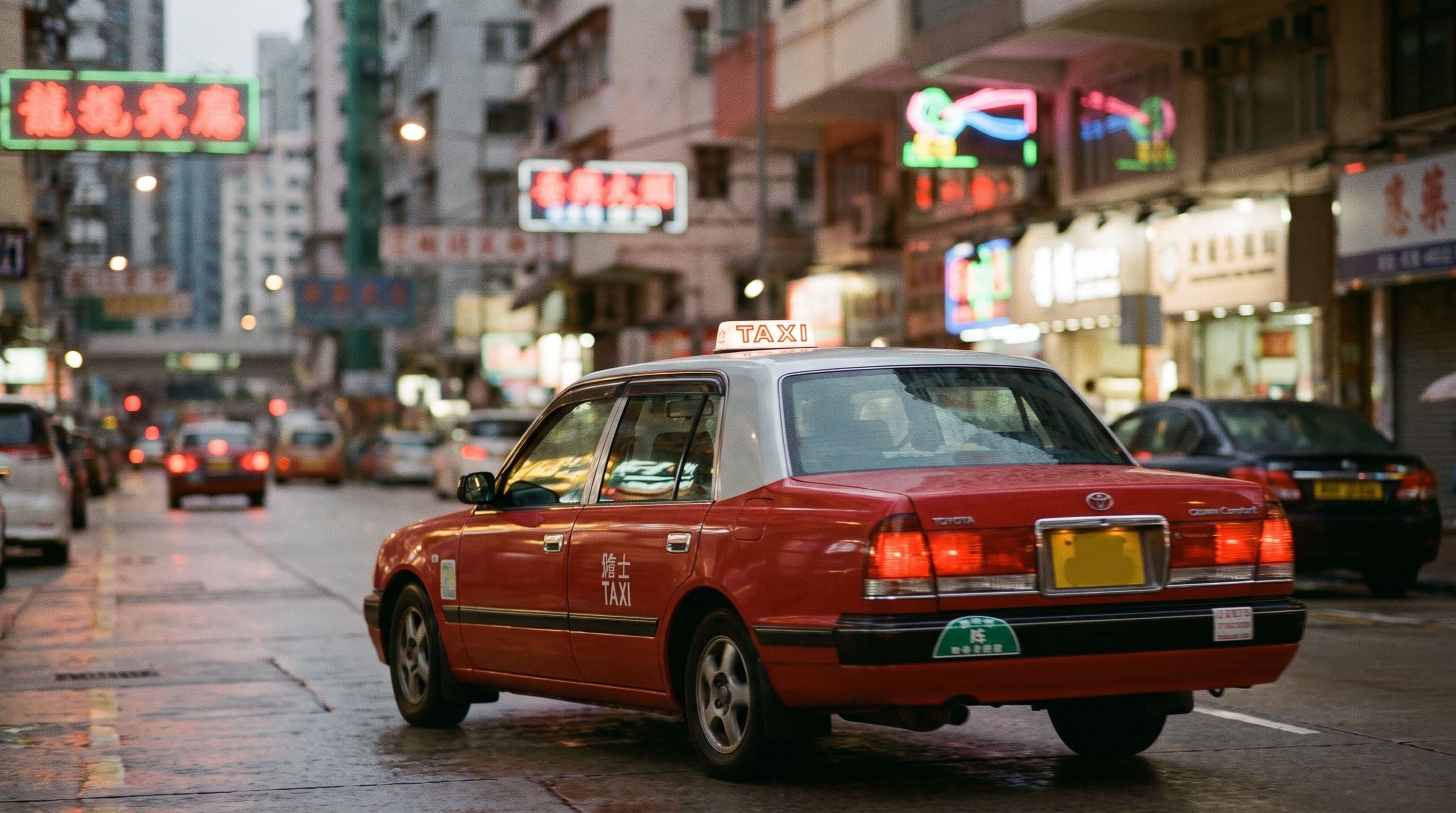
Three taxi colours, three fare tables, and one rule that catches almost every visitor: the meter is not optional. This Hong Kong taxi guide covers what each colour actually covers, what a real fare looks like once tolls and luggage are added, how to book one without knowing any Cantonese, and whether Uber is worth bothering with.
Red, green or blue: which taxi do you actually need?
Hong Kong runs 18,163 licensed taxis across three colours, and almost all of them are red. Red (urban) taxis cover the whole city except Lantau Island and Tung Chung Road, so if you're on Hong Kong Island, in Kowloon, or in most of the New Territories, red is your default. There are 15,250 of them, so they're rarely hard to find outside the small hours.
Green taxis (2,838 licensed) only serve the remoter New Territories: Tuen Mun, Yuen Long, Tai Po and Sai Kung. They can't take you into the urban core, so a green cab is only useful if you're already staying or heading out in one of those districts. Blue taxis are the rarest by far, just 75 on the road, and they're restricted to Lantau Island, the airport, and Disneyland; you won't see one anywhere else. Landing at the airport and heading somewhere on Hong Kong Island or Kowloon, a red taxi from the arrivals rank will actually get you further than a blue one; see every option for getting from the airport to the city for how a taxi stacks up against the train and buses on price and time.
What a taxi actually costs
Fares run by taximeter, and the three colours price differently. A red taxi starts at HK$27 for the first 2km, then adds HK$1.90 for every 200m (or minute of waiting) after that. A green taxi starts at HK$23.50 for the first 2km, then HK$1.70 per 200m. A blue taxi on Lantau starts at HK$22 for the first 2km, then HK$1.70 per 200m. All three drop to a lower per-unit rate once the fare passes a set threshold, so a long ride costs proportionally less per kilometre than a short one.
For context, a short 2–3km hop across town in a red taxi typically lands somewhere in the HK$30–45 range before any tolls, which is cheap by the standards of a major global city. It's also worth weighing against the alternatives for the same trip: the Airport Express's fixed fare if you're coming from the airport, or the flat-fare Hong Kong tram if your route runs along the northern strip of Hong Kong Island: much slower, but a fraction of the price.
Extra charges that show up on the meter
Two fees catch people off guard. Every piece of luggage (including a stroller) is HK$6, and pets travel for HK$5 each. The other is tunnel tolls: if your route crosses one of Hong Kong's harbour or hill tunnels, that toll is added on top of the metered fare, not included in it. The amount depends on which tunnel your driver takes, so if it matters for your budget, ask before you get in rather than after.
As of 1 April 2026, every taxi in Hong Kong is required to accept at least two forms of e-payment (one QR-code based, one non-QR), on top of cash, under a Transport Department rule. In practice that means Octopus or PayMe now works in the vast majority of cabs, not just the ones that happened to install a reader. Cash is still worth carrying as a backup, but you're no longer relying on a driver's personal setup to tap out.
How to book one
The simplest option is a taxi stand, common outside hotels, malls and MTR stations. Failing that, raise your arm at the curb for a passing cab; the rooftop light tells you if it's free (lit up means available, off means occupied or off-duty). Phone dispatch hotlines exist for all three colours if you need a pickup from somewhere quiet. For an app-based option, HKTaxi is a dedicated taxi-hailing app that works like calling a cab to your exact pin, and DiDi Hong Kong offers a similar service.
Should you use Uber instead?
It's worth knowing what you're actually booking. Uber's private-car rides sit in a genuine legal grey zone in Hong Kong: the Court of Final Appeal has upheld that driving passengers for a fee without a hire-car permit is illegal, and most Uber drivers here don't hold one. Lawmakers have since passed a bill to license and regulate ride-hailing platforms, so this is expected to change, but it hasn't fully landed yet.
The easy workaround is the "Uber Taxi" option inside the Uber app. It doesn't use a private car at all. It books you a real, licensed red taxi through the app, same driver and same meter you'd get by hailing one on the street, just without needing to explain your destination out loud. For a first-time visitor, that's arguably the least stressful way to get a taxi in Hong Kong.
A few things that will save you a headache
Avoid trying to flag a taxi during the shift-change window around 3:45–4:15pm; a lot of drivers head back to base to swap over and empty cabs get scarce right when everyone else is also trying to get somewhere. The meter is always used and off-meter price negotiation is illegal, so a driver quoting you a flat price up front is a red flag, not a discount. Having your destination written in Chinese characters (a hotel business card works well) avoids the single most common source of confusion, and if you need to give quick directions, "jun jo" means turn left and "li dou" means stop here.
Always ask for a printed receipt, especially for a longer ride: it has the taxi's registration number on it, which is what you need if you leave something behind or want to file a complaint. If you do leave something in a cab, Hong Kong's lost property hotline for taxis is +852 1872 920, staffed 24 hours.
Quick answers
Which taxi service is best in Hong Kong? Red taxis, for almost everyone: they cover the whole city except Lantau. Green only makes sense if you're specifically in Tuen Mun, Yuen Long, Tai Po or Sai Kung, and blue only applies on Lantau Island, the airport or Disneyland.
Is it better to use a taxi or Uber in Hong Kong? A licensed red taxi, or the "Uber Taxi" option inside the Uber app, is the safer bet. Uber's regular private-car rides are still in a legal grey area here.
Is it expensive to take a taxi in Hong Kong? Not by big-city standards. A short 2–3km red-taxi ride typically runs HK$30–45 before tolls, with luggage adding HK$6 a piece.
How do you order a taxi in Hong Kong? Use a taxi stand, raise your arm at the curb, call a phone dispatch hotline, or book through an app like HKTaxi or Uber Taxi.
A taxi is the fastest way to cross town when you're short on time, but it's rarely the cheapest or most scenic. If you're just crossing the harbour, the Star Ferry does the same trip for a fraction of the fare with a better view.
Planning the rest of your trip? See our guide to Hong Kong's Cross-Harbour Tunnel Buses: Routes, Fares & Tips.