Hollywood Road: Hong Kong's Antiques and Art Street
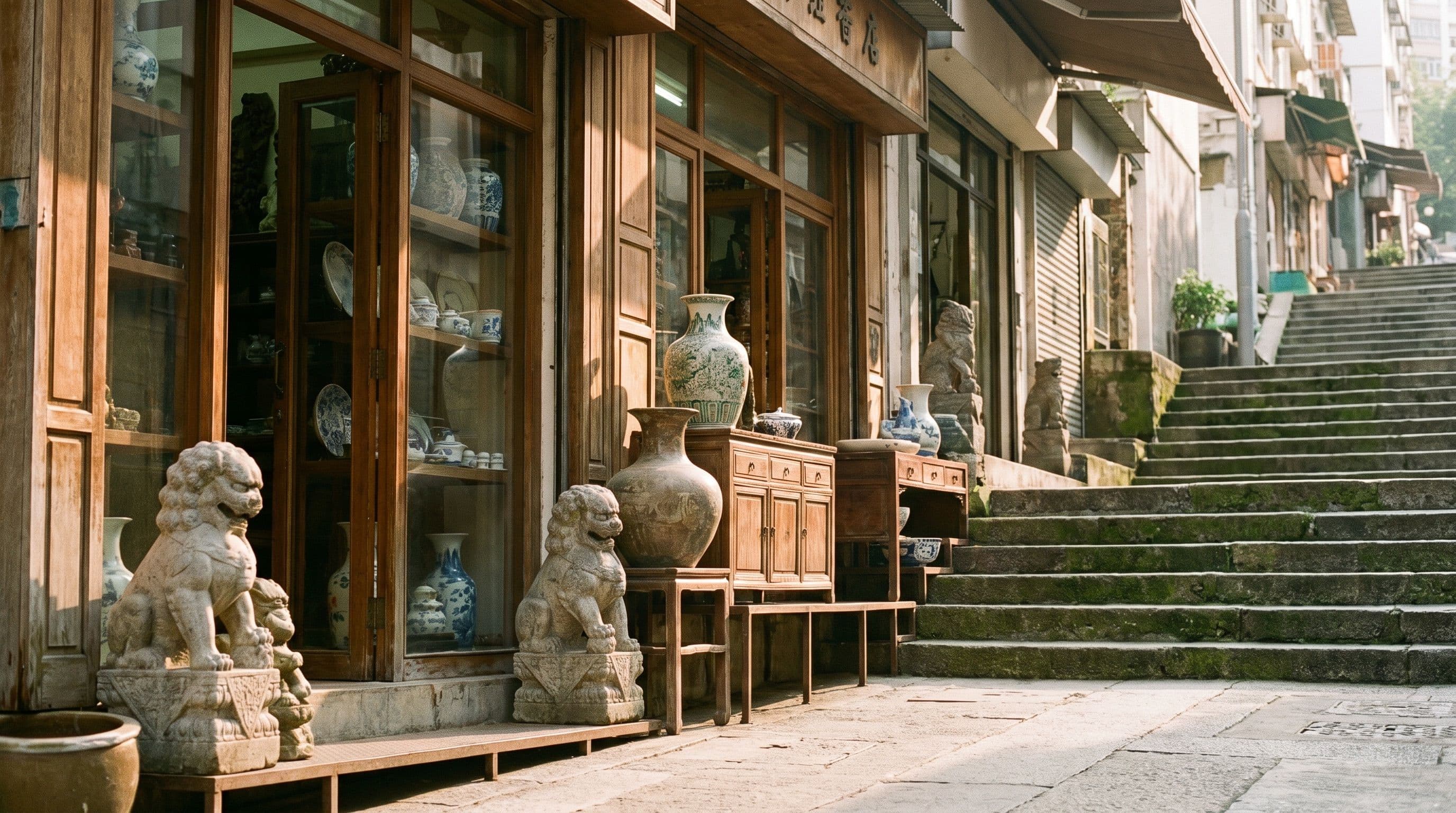
Hollywood Road is Hong Kong's antiques street, and it has been trading in old things for longer than most of the city has existed. It runs between Tai Kwun and Man Mo Temple in Sheung Wan, and the shops along it and the parallel Cat Street sell everything from museum-grade Ming furniture to cheap Mao-era junk. Those two ends of the market sit one street apart, which is most of what you need to know before you go.
Here's what's actually on the shelves, what things cost, and how to get there without walking the wrong way out of the MTR station.
A street older than most of the city around it
Hollywood Road dates to 1844, making it one of Hong Kong's earliest roads. It originally ran close to the waterfront; decades of land reclamation have since pushed the harbour hundreds of metres away. According to local histories, the name has nothing to do with the film industry: it's said to come from the Hollywood, or holly, trees that once lined the road.
The antiques trade goes back almost as far. Sailors and merchants used the street to sell Chinese artifacts to European buyers in the colony's early decades, and by the 1920s it had a reputation as the place to hunt for genuine finds. That history is why the street still reads as a working market rather than a tourist reconstruction, though it isn't untouched: long-established, family-run dealers here have been squeezed in recent years by rising rents and a broader decline in bricks-and-mortar antique retail.
Hollywood Road vs Cat Street: two different price tags
Treat the two as separate stops. Hollywood Road proper is the higher end: Ming-style furniture, jade, carpets and rugs, lacquerware, and both Chinese and contemporary paintings, sold out of long-established galleries that expect serious buyers.
Cat Street, officially Upper Lascar Row, is a roughly 200-metre lane running parallel to Hollywood Road, and it's the cheaper, browsable version. More than 30 stalls sell jade, ceramics, bronze Buddha statues, copper pots, old furniture, Mao-era memorabilia, Chinese coins, snuff bottles, jade bracelets, Cultural Revolution posters, and Bruce Lee items. The name is older than the merchandise: it comes from a local term for buyers of stolen goods, back when the lane had a rougher reputation for handling items of unclear origin. It went legitimate as a second-hand antiques market after the Second World War.
Prices on Cat Street are set to be haggled, not accepted at face value. Compare the same item across two or three stalls before you commit, and go on a weekday if you can: Saturdays bring crowds and traffic that make browsing slower than it needs to be.
What you'll actually see
On Hollywood Road: Buddha statues, Terracotta Warrior replicas, Chinese porcelain, Ming-style furniture, jade, carpets, lacquerware, and art ranging from traditional scrolls to contemporary work. On Cat Street: the same categories at a fraction of the price, plus the smaller collectible items that don't show up on Hollywood Road, like coins, snuff bottles, and Cultural Revolution-era posters.
One stop worth knowing about rather than expecting to walk into: Liang Yi Museum, a private museum on the same stretch holding a serious collection of Ming and Qing furniture, including pieces you're invited to touch and chairs you can sit in. It only admits pre-booked, docent-led private groups, so check its own booking process before you plan a visit around it.
Getting there
From Sheung Wan MTR station, take exit A2, walk along Hillier Street, turn right onto Queen's Road, head toward Ladder Street, then turn left onto Hollywood Road. From Central MTR station, the Central-Mid-Levels Escalator is the more scenic route up: ride it partway and cut across to Hollywood Road rather than climbing the hill on foot. Bus routes 26 and H1 also stop nearby.
The street itself runs from Tai Kwun, the former Central Police Station compound, at one end, to Man Mo Temple at the other. Both are worth building into the same trip rather than treating Hollywood Road as a stand-alone stop.
When to go, and what else is on the block
Shops generally open around 11am and close by 6pm, and a fair number stay shut on Sundays and public holidays, so a weekday afternoon is the safest bet for a full street of open doors. If antiques aren't your main draw, PMQ, the converted 1960s police dormitory now packed with local design studios and food stalls, sits just off Hollywood Road and makes a natural add-on to the same afternoon.
Quick answers
- Why is Hollywood Road famous in Hong Kong? It's the city's original and best-known antiques street, running from Tai Kwun to Man Mo Temple, and it's kept that reputation since the early 20th century thanks to a genuine, still-operating trade in Chinese art and furniture rather than a manufactured tourist market.
- Where is the best souvenir shop in Hong Kong? For something affordable and easy to carry home, Cat Street beats Hollywood Road proper: its stalls sell smaller, cheaper items like jade bracelets, coins, and Bruce Lee memorabilia, where the galleries up on Hollywood Road are geared toward serious furniture and art buyers.
- What is there to see on Hollywood Road? The antique and art galleries themselves, Cat Street's stalls one block over, Man Mo Temple and Tai Kwun at either end of the street, and PMQ a short walk away. Liang Yi Museum is on the same stretch but needs a pre-arranged, docent-led visit.
- What items are cheap to buy in Hong Kong? On Cat Street specifically, Chinese coins, snuff bottles, jade bracelets, and Cultural Revolution-era posters are among the cheapest genuinely collectible items on offer. Treat any price as a starting point for negotiation, not the final number.